Choose one awkward area
Taking organization photos does not mean tidying the whole house. Choose an area that causes real inconvenience, such as the entry shelf where you search for keys each morning or a drawer of tangled chargers. A clear boundary makes changes easier to recognize in comparison photos.
The aim is to find places that suit your life, not simply attractive before-and-after pictures. Describe a specific problem: ‘Take out the cable I use often without pulling other things along,’ rather than ‘Get rid of lots of things.’ This is an editorial suggestion for recording everyday life.
Record the way you actually use the space
If you arrange things neatly before the first photo, the original problem disappears. Photograph the usual state, removing addressed envelopes and private documents first. The picture helps explain the layout; it is not evidence of someone's failings.
Replace judgments such as ‘Why is this so messy?’ with an action: ‘The everyday scissors are at the back, so I have to remove things in front.’ Note problems the photo cannot show. In a shared space, discuss everyone's needs before moving their belongings to suit your own preferences.
Pair each change with its reason
Take the after photo from a similar direction and describe the main change. For example: ‘Everyday scissors in front, occasional wrapping tools at the back. I moved them so I could reach them with the drawer half open.’ A note saying only that it looks nice gives little guidance for future changes.
New location: say which item moved from where to where.
Reason: describe the difficulty with taking out, returning, or sharing it.
Remaining problem: identify items still without a place.
What to keep: leave arrangements that already work alone.
Photograph signs of use about a week later
The immediate result does not tell you whether a layout suits everyday life. After about a week, revisit the same area and see which items returned to their places. A week is an example comparison interval, not a required schedule. Check after you have had a chance to use it.
If it becomes messy again, do not label the record a failure. An item left out may have a distant storage spot or be hard for another person to find. Avoid assuming a cause. Record an observation and a question: ‘This keeps returning to the desk. Could it live closer to where it is used?’
Compare real actions, not item counts
More empty space in a photo does not necessarily mean easier use. Can you retrieve and replace frequently used items? Can everyone distinguish their belongings? If adding storage boxes creates more steps to open, record that inconvenience too.
Decide separately whether to discard things. Do not dispose of family members' belongings for your record, or remove important papers and unfamiliar parts without checking. Photos provide clues about layout changes, not an automatic assessment of whether items are needed.
Choose one next change from the three stages
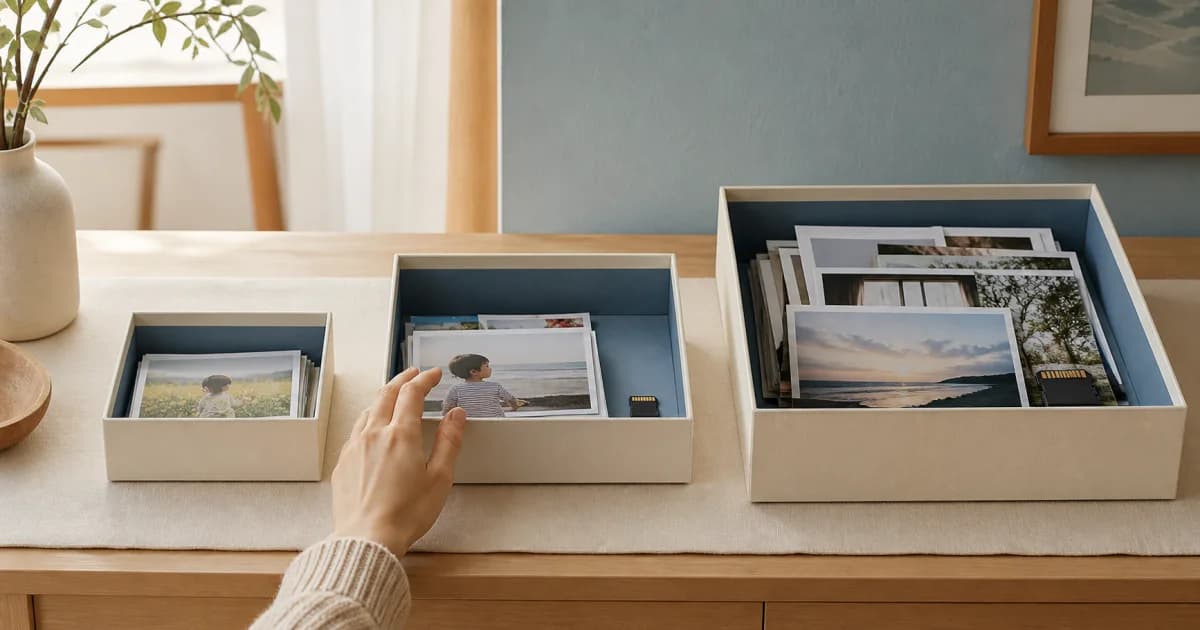
In Pogaem, record the original inconvenience, the arrangement on tidying day, and the result after use as photos and text on their respective dates. Use a consistent area name to connect entries. Avoid combining all changes as though they happened on one day.
Next time, change just one problem you noticed. A small adjustment such as ‘move the scissors forward’ is easier to explain than rebuilding the whole arrangement. If it works well, stop recording. The purpose is to find places that suit your life, not to keep organizing indefinitely.
Frequently asked questions
What if the before photo looks very messy?
A private record can help you examine the actual problem. Exclude private information and belongings family members do not want shown. If a photo feels uncomfortable, describe the difficult action in text instead.
Must I take another photo exactly one week later?
No. A week is an example for reviewing the result after use. Check once you have had a chance to use the new layout; different areas need not follow the same schedule.
Does renewed mess mean the organization failed?
There is no need to judge it that way. Look at which items did not return and why, then address one confirmed inconvenience in the next arrangement.