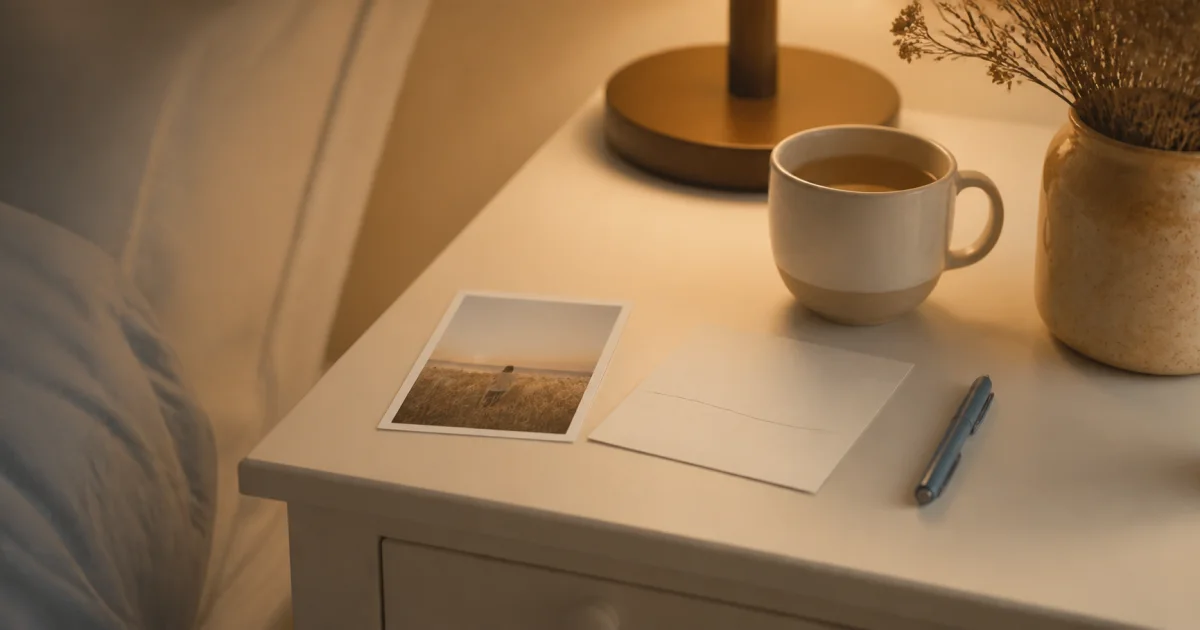
Add one thing the photo cannot show
A photo can show the food on a table without explaining why you chose it. A photo diary fills that gap. Unlike a place guide or collection of beautiful images, it centers the memory of the person who experienced the scene.
Writing only ‘I drank coffee’ beside an empty cup repeats the visible detail. ‘I had time before an appointment, so I sat alone. The quiet window seat is one I would choose again’ preserves a decision. These are writing examples, not actual user reviews.
Captions and diaries answer different questions
A caption answers ‘What is visible?’ while a diary asks ‘What was this moment for me?’ Every photo does not need a profound reflection. Why you raised the camera or whom you were waiting for can provide enough context.
A descriptive record is fine if you only need a dish or place name. For finding it again, that may be the most useful information. Captions are not a wrong approach; they serve another purpose. You can combine information and a personal story.
A photo diary does not have to be shorter than a written diary
A conventional diary evokes scenes in words; a photo diary starts with an image. Length does not define the difference. Write a long reflection for one image or one sentence for several, deciding how much the photos can show without explanation.
You need not cover the whole day. If a tree on the way home is all you want to remember, choose it. If summarizing every event makes starting difficult, reduce the unit from ‘one day’ to ‘one scene.’
Start by checking the date, photo, and reason
Ask whether your future self will recognize the entry before worrying about other readers. The date says when, the photo shows the scene, and a line explains why it mattered. For a title, choose a distinguishing phrase such as ‘The rainy commute’ instead of ‘Today.’
Date: distinguish the event day from the day you are writing retrospectively.
Photo: choose a scene that recalls the story, not merely a pretty picture.
Note: add unseen context, the gist of words you heard, or the reason for a choice.
Audience: decide whether it is for you alone or to show a companion.
Allow days without photos and memories with gaps
Do not fill a photo-free day with an unrelated image presented as that day's scene. Write text or skip it. If using a later photo of a similar place as reference, label it ‘photo taken the next day’ to avoid confusion.
For old photos, distinguish clearly remembered facts from current guesses. It is fine to leave companions unidentified if you do not know. Marking uncertainty makes later clarification easier than inventing a complete story.
Make one entry before choosing an app
Choose an existing phone photo you want to revisit and answer ‘Why did I keep it?’ Writing one entry clarifies whether you need long text, dated photo groups, or a private space. You need not create many topics immediately.
Pogaem groups photos and short notes by date. Begin with one everyday entry and check whether its context makes sense when you reopen it. The starting standard is a record you can reread, rather than public polish or a fully filled calendar.
Frequently asked questions
Can photos alone be a photo diary?
Yes. Photos can form a personal record, though a date and short reason help you understand the scene later.
Must I take new photos every day?
No. Record only days you want to remember or use existing photos. When writing later, distinguish the event date from the writing date.
Can I start if I am not good at photography?
Yes. You are preserving personal memories, not necessarily making artwork. Choose recognizable scenes rather than focusing on composition.